avatar
0xTodd
69,216 Twitter followers
Follow
Posts
avatar
0xTodd
Thread
Dayu's analysis of Circle obtaining its banking license is quite good, but I see some questions remain, so I'll try to add some explanations. Is Circle getting a banking license impressive? Yes, it is. In fact, it's a "National Trust Bank" license, a federal-level license, which is far superior to state-level licenses. There are only about 60 such licenses in the entire US, making it highly valuable. A significant portion of Circle's insanely high compliance and legal costs goes into this area. Will Circle use my money for lending after opening a bank? No, it's a trust bank; it won't engage in deposit-taking or lending, unlike the situation with Silicon Valley banks. Can Circle monopolize the US stablecoin market with this license? Not necessarily. Five licenses were approved this time, and Ripple and Paxos also received them. PS: Paxos applied for many years but never saw any results, always holding a state-level license; this time it's upgraded from state to federal (similar to upgrading from a college degree to a university degree 🤣). Circle will be keeping its money in its own bank, which makes things even easier for them to operate in secrecy, right? Dude, this is a federal license; they can't just mess around with it. Federal regulators can check it anytime, and it will only be stricter and more cautious than before. Won't Circle offend BlackRock? No, it won't. Currently, Circle issues USDC, BlackRock manages it, and BNY Mellon in New York handles custody. In the future, it will be Circle issuing USDC, BlackRock managing it, and Circle Bank handling custody. If they offend anyone, it will be BNY Mellon, not BlackRock. Wait, why is BlackRock managing Circle's USDC? Because currently, most USDC reserves aren't just held in bank accounts. They're held in a specific SEC-registered money market fund called the Circle Reserve Fund (USDXX). This fund is managed by BlackRock, and the money is currently held in custody at BNY Mellon. However, in the future, most of it may be moved to Circle's own bank. What's the point of Circle having a bank? I still can't spend it, right? I think it's only a matter of time. Even if USDC can't be used, it definitely can be done through some apps; it's just a matter of how much wear and tear. Stablecoins are real money, and this is definitely an inevitable trend. |2024111120231_|
USDC
0.02%
avatar
0xTodd
Thread
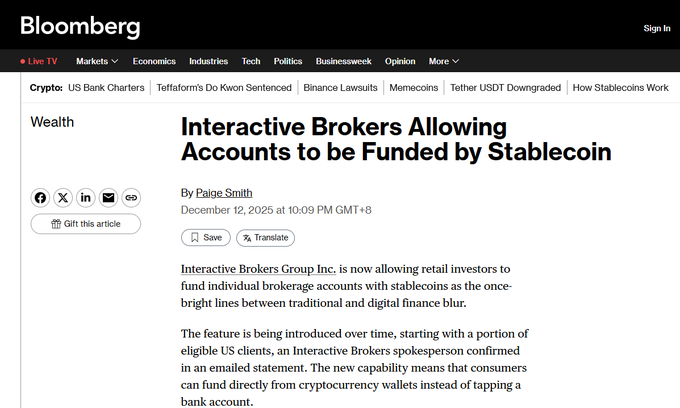
Interactive Brokers (IBKR) has supported USDC deposits ($USDC), further validating my point. As one of the world's largest brokerages, what does IBKR's support for USDC deposits mean? In a loose sense, IBKR could also be considered an L1 blockchain 😂. Previous projects involving putting securities on-chain, and even securities trading chains, have somewhat lost their luster. Since they're all data center blockchains anyway, instead of my money running on some unknown small chain, trading security tokens managed by some unknown market maker and held by some unknown brokerage, it's better to legitimately deposit USDC into IBKR and enjoy truly top-tier global liquidity and security. Of course, this isn't a complete rejection of security tokens like RWA. After all, there's still DeFi on the chain, and some people can't open accounts with IBKR yet. However, brokerages supporting stablecoin deposits is a major trend. The US is pushing it, Hong Kong is pushing it, and Singapore is hesitant (but I guess they'll follow suit once the US and Hong Kong have no problems). Regarding brokerages specifically, while some people can't open an Interactive Brokers account, mainland Chinese residents can still open accounts with many foreign brokerages, so this is only a matter of time. ---Separator--- Some other information: Interactive Brokers' stablecoin deposit gateways this time are Paxos and ZeroHash. Depositing USDC results in USD being credited directly to the account. The gateway will take a 0.3% conversion fee (for reference: this is really low, much lower than the 1%-1.5% withdrawal fees common in our industry). I originally used HashKey OTC, which had a fee of about 0.2%. This fee is slightly higher by 0.1%, but the pain is not noticeable. Moreover, traditional OTC withdrawals first go to the bank, then to the brokerage, but rapid in-and-out transactions can cause banks to be sensitive, so bypassing this step is quite good. The monthly limit is $100,000, which is enough for retail investors. I wonder if there are any special channels for increasing the limit for large investors. twitter.com/0xTodd/status/2000...
USDC
0.02%
loading indicator
Loading..