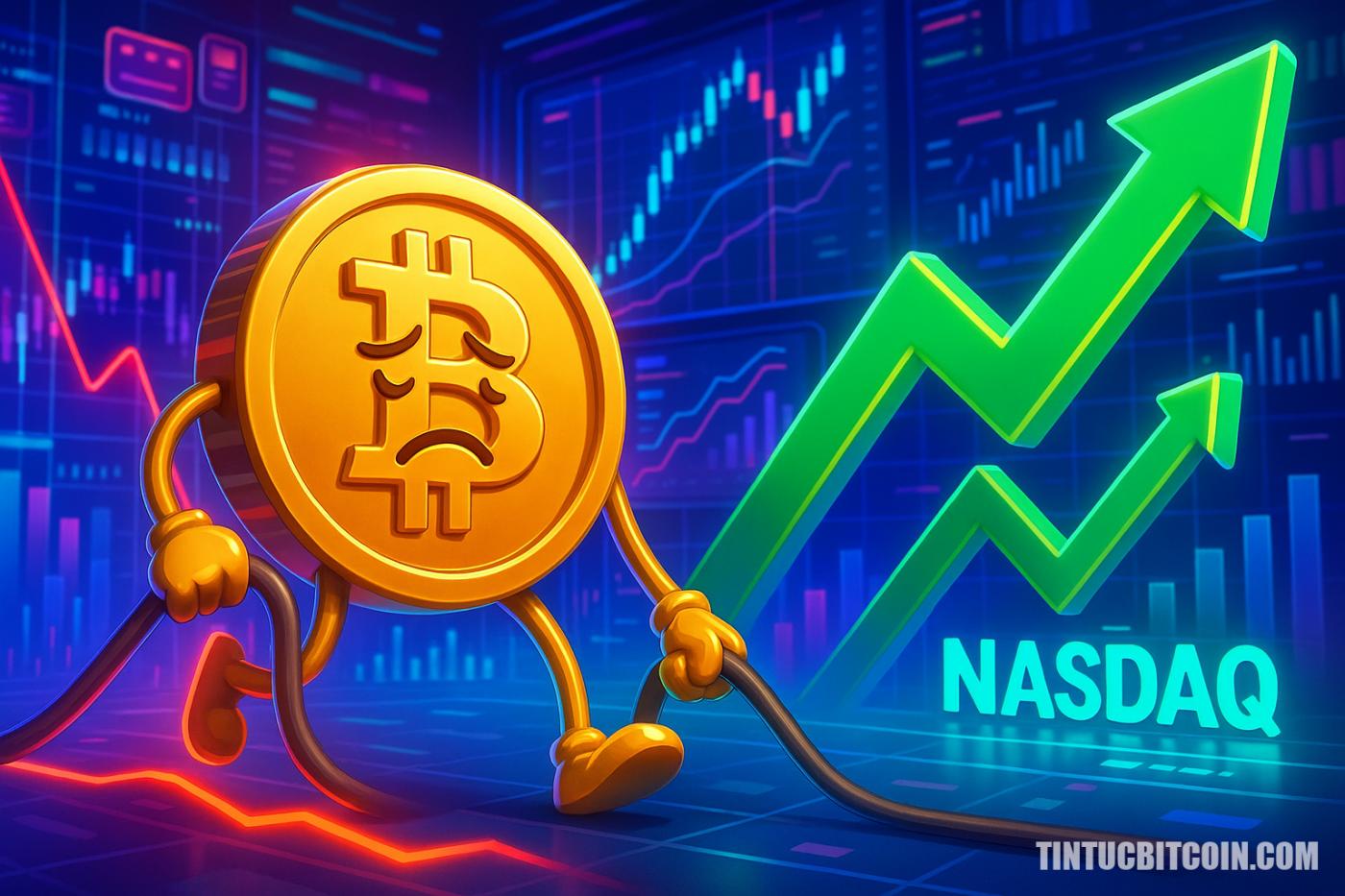
Bitcoin's correlation with the S&P 500 and Nasdaq has fallen to its lowest level of the year, highlighting a clear decoupling between crypto and stocks amid changing US trade policy.
After concerns about tariffs and trade eased, US stocks maintained their upward momentum, while Bitcoin came under pressure in the fourth quarter. The performance gap widened, resetting expectations about BTC 's Vai in risk portfolios and how it reacts to macroeconomic volatility.
- BTC decoupled from US stocks, correlating with the S&P 500 and Nasdaq hitting yearly Dip .
- In the long term, BTC 's CAGR outperforms that of stocks, although the short-term outlook is less positive.
- This decoupling both reduces the spread of risk and limits the benefits from stock price rallies.
The Bitcoin-US stock market correlation has hit a yearly Dip .
BTC 's correlation with the S&P 500 and Nasdaq fell to its lowest level of the year as the market corrected following signals about tariffs and trade, while stocks maintained their upward momentum and BTC struggled to recover.
According to analyst Darkfost , BTC 's correlation coefficient with the S&P 500 is around -0.299 and with the Nasdaq is close to -0.24. US stocks continue to rise while Bitcoin is under pressure after an approximate 36% drop in 2025, widening the performance gap.
In this decoupling environment, traders can monitor funding, open interest (OI), and liquidation clusters on BingX to assess Derivative sentiment and trend sustainability, thereby adjusting risk management when stocks and cryptocurrencies are no longer in sync.
The S&P 500 has risen approximately 2.06% since the beginning of the quarter and is projected to rise nearly 16% in 2025; the Nasdaq has increased approximately 4.76% in the fourth quarter and is expected to rise nearly 20.12% in 2025. In contrast, BTC 's recovery efforts have been stalled. Its correlation with Gold and the USD Index has weakened, while US Treasury bonds have remained relatively stable.
Bitcoin's long-term performance remains superior.
Over longer timeframes, BTC 's CAGR is approximately 47% per year over 5 years, significantly higher than US stocks, despite strong short-term volatility.
CAGR helps filter out short-term noise to reflect sustainable growth. Over the same period, the S&P 500 averaged nearly 17% per year, and the Nasdaq around 20% per year. This suggests a long-term correlation between BTC and stocks is asymmetrical, leaning more towards yield differentials than short-term positive correlations. Source: Checkonchain.
The decoupling reshaped BTC 's Vai in the portfolio.
This decoupling strengthens BTC as a distinct asset class, reducing the potential for risk spread from stocks but also limiting direct gains when stocks rise.
The shift of Capital towards AI and data centers has left crypto unaffected by stock market rallies. With uneven macroeconomic influences, BTC could experience greater volatility driven by specific catalysts such as Derivative flows, on-chain liquidation , and cyclical narratives. Source: S&P Global, Checkonchain.
Conclude
The decoupling does not weaken the long-term argument for BTC ; it repositions BTC 's Vai in the market and underscores the importance of holding time and risk management discipline.
- Bitcoin's decoupling from stocks reflects a changing market structure, but does not negate its long-term prospects.
- Greater independence could increase short-term volatility, but it also opens up different ways for BTC to react to macroeconomic shocks.
Frequently Asked Questions
Why has the correlation between BTC and the S&P 500 and Nasdaq dropped sharply?
Concerns about tariffs and trade dampened risk sentiment, causing the upward momentum of stocks and the trajectory of BTC to diverge. Stocks maintained positive momentum, while BTC came under pressure after a sharp decline, dragging the correlation down to its lowest level of the year.
Does decoupling help reduce portfolio risk?
Possibly. When correlation is low, shocks in stocks are less likely to spill over into crypto. However, BTC has its own unique risks, so short-term volatility may increase. Investors still need to allocate their funds wisely and monitor Derivative flows and liquidation.
In the long term, will BTC remain more attractive than stocks?
Five-year data shows BTC 's CAGR is approximately 47% per year, higher than the S&P 500 (~17%) and Nasdaq (~20%). However, past performance does not guarantee the future; high volatility requires discipline and a long-term perspective.