Alexander Zandt, CEO: "Korea is a strategic market at the intersection of tokenized finance and consumer apps."
Zilliqa, the pioneer of sharding, is poised to conquer Korean businesses and the financial sector with thousands of transactions per second and two-second finality.
);)
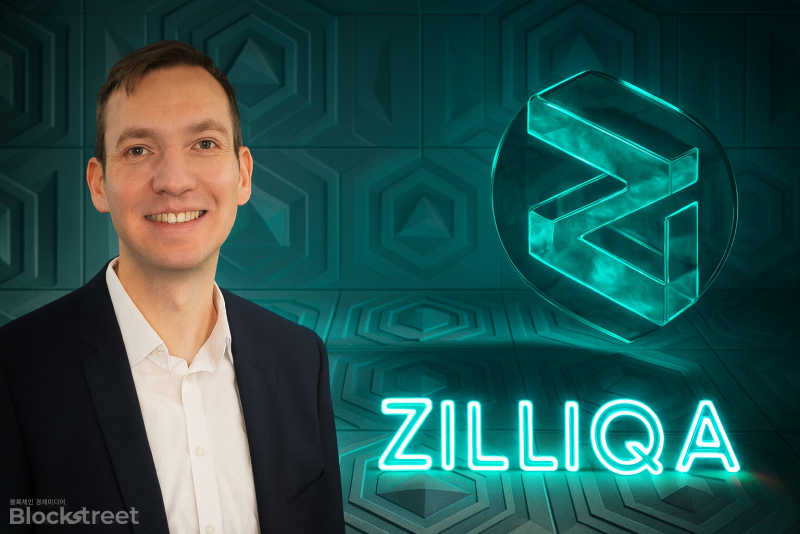
Alexander Zahnd, CEO and CFO of Zilliqa, recently expressed strong interest in the Korean market in an exclusive interview with BlockStreet.
Zilliqa, the first Layer 1 (L1) blockchain to implement sharding technology, recently launched "Zilliqa 2.0," significantly enhancing scalability, security, and interoperability, and has fully launched its foray into the institutional and corporate markets. CEO Zand is a financial professional with over 10 years of experience in traditional financial institutions, including UBS and KPMG. He holds the Chartered Financial Analyst (CFA), Chartered Risk Manager (FRM), and Chartered Alternative Investment Analyst (CAIA) designations.
In this interview, he detailed Zilliqa 2.0's differentiated sharding architecture, its approach to bridging the gap between traditional finance (TradFi) and blockchain, its strategy tailored to the Korean corporate and regulatory environment, and its infrastructure to support real asset tokenization (RWA).
The Evolution of Sharding Technology... "Horizontal Scalability Without Layer 2"
Q. Zilliqa is the first public blockchain to implement sharding technology. How does Zilliqa 2.0's sharding architecture differ from Ethereum's Danksharding or other popular Layer 2 (L2) scaling solutions in the Korean market?
"Zilliqa was the first public network to demonstrate that sharding could work at scale in a production environment, a concept that was largely theoretical at the time.
Our challenge today is how to evolve this idea to meet the expectations of today's developers. Ethereum's dunksharding focuses on providing data availability to Layer 2 systems, with most implementations moving off the base chain.
Zilliqa follows a different logic. We maintain a high-performance Ethereum Virtual Machine (EVM)-compatible base layer, but allow applications to be split into modular components when they require predictable throughput.
For Korean developers already familiar with Layer 2, the practical difference is that they don't need to build and operate their own rollup infrastructure for scaling. Develop once on the EVM and scale horizontally within the network as use cases demand.
The goal is to provide the performance benefits associated with Layer 2 systems without decentralizing liquidity or adding operational overhead."
Bridging the Gap Between Traditional Finance and Blockchain... "Verifying Corporate Identity with vLEI"
Q. You have a background in traditional finance at UBS and KPMG. What specific gaps have you identified between traditional finance requirements and existing blockchain infrastructure, and how will Zilliqa 2.0 address the institutional entry barriers currently facing Korean financial institutions?
"Traditional finance has little tolerance for uncertain behavior. Payments must be final, reporting must be auditable, and governance models must be clear. Early blockchain infrastructure failed to provide this.
The gap was not only about throughput, but also about determinism, integration convenience, and identity verification. If a Korean bank were to issue a digital asset, it would have to prove the issuer's identity and lifecycle integrity to regulators and external auditors.
This is why standards like the Verifiable Legal Entity Identifier (vLEI) are so useful. They provide a verifiable identity framework for legal entities, upon which assets can be issued and managed.
Zilliqa provides an execution environment with deterministic finality and EVM-native tooling, allowing institutions to integrate using the same standards they already use elsewhere. This eliminates the need to build custom systems for blockchain pilots and allows banks, insurers, and asset managers to operate with the level of assurance they expect from core infrastructure.
Targeting Korean companies like Samsung and LG... "Incorporating control into public infrastructure."
Q. Korean companies such as Samsung, LG, and major banks are actively exploring blockchain integration. What is Zilliqa's value proposition for Korean corporate clients, and are there any specific partnership discussions or expansion plans for the Korean market?
"Korean companies take a pragmatic approach to blockchain. They want the benefits of public infrastructure with the control and clarity required in a regulatory environment.
Zilliqa provides a way to run consumer-scale applications on a high-performance public execution layer, while, when necessary, running sensitive logic in a controlled environment on the same network. This avoids the isolation between experimental pilots and separate private systems, providing a clear path from initial testing to full deployment.
The fact that everything is EVM-compliant also reduces integration costs, as Korean companies already have the talent and tooling to meet the standard.
Korea is a strategic market for us, and we are actively exploring opportunities in the region. Our focus is on digital asset infrastructure, tokenization of financial products, and consumer-facing applications where performance and regulation intersect.
Support for RWA tokenization... "Transparently replicate the entire asset lifecycle."
Q. You have expertise in tokenomics and DeFi strategies. What is your view on the real-asset tokenization (RWA) trend, which is gaining significant attention in Korea, and how does Zilliqa 2.0's infrastructure support institutional-grade RWA applications?
"RWA tokenization is a natural evolution, where financial products are already distributed digitally and regulators are involved in defining a clear framework.
To move beyond small-scale pilots, tokenization requires more than simply issuing tokens. It requires replicating the entire asset lifecycle in a transparent and auditable manner.
Zilliqa supports this by providing deterministic settlement, predictable execution, and the ability to embed compliance logic at the application layer. If issuers need to implement transfer restrictions or reporting obligations, they can do so without modifying the base network.
Combined with standards like vLEI to identify issuers, you have the essential building blocks for institutional adoption. This is where tokenized assets can exist alongside traditional financial instruments, rather than being experimental abstractions.
Balancing regulatory compliance and decentralization... "Mandatory enforcement at the application layer."
Q. Korean regulators are implementing stricter compliance frameworks for digital assets. As a professional holding the CFA, FRM, and CAIA designations, how do you balance regulatory compliance with decentralization? What compliance features does Zilliqa 2.0 offer for regulated markets like Korea?
Compliance and decentralization operate at different layers. The base network must remain open and permissionless, while regulated entities must enforce obligations at the application and governance layers.
Attempting to embed regulation into core protocols fails to satisfy all jurisdictions and weakens the network's resilience.
A better model would allow institutions to operate on public infrastructure with verifiable identities, clear audit trails, and predictable payments. Zilliqa fits this approach.
Deterministic finality simplifies reporting. EVM compatibility means existing compliance tools can be reused. And identity frameworks like vLEI enable regulated entities to be recognized on-chain without requiring a gatekeeper at the protocol level.
In a market like Korea, which has a progressive regulatory mindset, this architecture allows decentralization and regulatory requirements to coexist in a reasonable way."
High-performance infrastructure... "Thousands of transactions per second, finality within two seconds."
Q. High-throughput infrastructure is essential for mass adoption. Could you share specific performance metrics (TPS, time to finality, cost per transaction) for Zilliqa 2.0? How does it compare to other popular L1 protocols in Korea, such as Klaytn and Ethereum? What real-world use cases will benefit most from Zilliqa's performance?
Zilliqa delivers high throughput and fast finality without forcing developers to change their approach. In controlled benchmarks, the network can process thousands of transactions per second, with finality typically under two seconds, and very low transaction costs.
The important aspect is that performance is not shared globally, but can be allocated to specific applications as demand increases.
Compared to other Layer 1 networks, the differentiator is less about headline TPS numbers and more about predictable performance as applications scale.
This is important in Korea, as local use cases often involve large user bases and low-latency expectations. Examples include gaming, loyalty programs, digital identity, and consumer-centric asset distribution. These applications require not only theoretical performance but also reliability under peak loads.
"The intersection of regulated finance and consumer apps presents opportunities over the next two to three years."
Q. Looking ahead to the next two to three years, where do you see the greatest opportunities for Layer 1 blockchain in the Asia-Pacific region, particularly in Korea? How is Zilliqa positioning itself to capture institutional and corporate adoption, and what role can Korean investors and developers play in the growth of the Zilliqa ecosystem?
"The next phase of Asia-Pacific will be driven by the intersection of regulated finance and scalable consumer applications. While the retail trading cycle will continue, the structural opportunities lie in tokenized deposits, digital fund distribution, on-chain credit products, and applications that connect brands and users through verifiable digital assets.
South Korea is particularly well-positioned, with proactive regulators, digital-first consumer behavior, and a long history of early adoption of new technologies by the corporate sector.
For Layer 1 networks to succeed, they must go beyond common developer platforms and integrate into existing financial architectures without diluting their core principles.
Zilliqa is positioned as a high-performance execution layer that provides the control institutions demand while utilizing the familiar EVM standard.
Korean developers will play a crucial role in this evolution, as they understand both the user experience and the regulatory landscape better than almost any other ecosystem. If we make it simple for them to build scalable, real-world products, adoption will naturally follow."
What is Zilliqa?
Zilliqa is a high-performance layer-1 blockchain platform built to power scalable, secure, and interoperable decentralized applications. As the first public blockchain to implement sharding, Zilliqa has continuously pushed the boundaries of blockchain infrastructure.
With the launch of Zilliqa 2.0, the platform is evolving to meet the needs of institutions, enterprises, and developers seeking high-throughput infrastructure with the trust, transparency, and flexibility needed for real-world adoption.
Alexander Zahnd, CEO
Alexander Zandt serves as Zilliqa's interim CEO and CFO and holds the Chartered Financial Analyst (CFA), Chartered Risk Manager (FRM), and Chartered Alternative Investment Analyst (CAIA) designations.
He has over a decade of experience at the intersection of traditional finance and digital assets, focusing on financial strategy, treasury management, and risk oversight. Prior to Zilliqa, he held leadership roles at UBS and KPMG, specializing in quantitative risk management and treasury operations.
He is also the founder of a financial consulting firm that advises cryptocurrency-native companies on tokenomics, compliance, and DeFi strategies. He resides in Zurich, Switzerland.
Joohoon Choi joohoon@blockstreet.co.kr