While most people are still anxious about short-term market fluctuations, a real financial transformation has quietly begun. With increasingly favorable policies, stablecoins are slowly moving to the center stage, becoming the core players in this revolution.
In July of this year, the US GENIUS Act officially came into effect, effectively bringing stablecoins into the "national team," which also means that crypto assets are about to enter the mainstream of global finance. Just as this policy wind was blowing strong, a project called Solulu quietly set its sights on this core track. It is targeting a massive market with an annual transaction volume exceeding $36.5 trillion. Instead of chasing get-rich-quick schemes or engaging in speculative hype, in the current volatile market, Solulu has chosen a more difficult but more significant path—building stablecoin service infrastructure, paving a truly smooth "financial highway" for the global flow of value.
Why is stablecoin service considered the next golden opportunity?
Let's look at some figures: In 2024, the total annual transaction volume on stablecoin blockchains reached $36.3 trillion. What does that mean? This surpasses the combined transaction volume of traditional payment giants Visa and Mastercard. The market size has also expanded rapidly, with a total market capitalization exceeding $270 billion and an annual growth rate remaining high at 28%. However, a crucial detail behind this hype has been overlooked by most: the penetration rate of stablecoins in real-world payment scenarios is a paltry 6%. What does this mean? The vast majority of stablecoins are still simply circulating within the financial system, failing to truly integrate into the daily lives of native crypto users. This huge opportunity has long been coveted by institutional investors.
Solulu has entered this largely untapped blue ocean market. More importantly, the implementation of the U.S. GENIUS Act explicitly requires stablecoins to be issued by licensed institutions and backed by U.S. dollar assets—this has cleared the way for compliant players like Solulu, allowing it to leap from an industry "pathfinder" to a "co-builder of a compliant ecosystem."
In the fiercely competitive blue ocean market, how will Solulu break through the encirclement?
The market is wide, but the competition is fierce. By comparing Solulu with several major players, its differentiated strategy becomes clear:
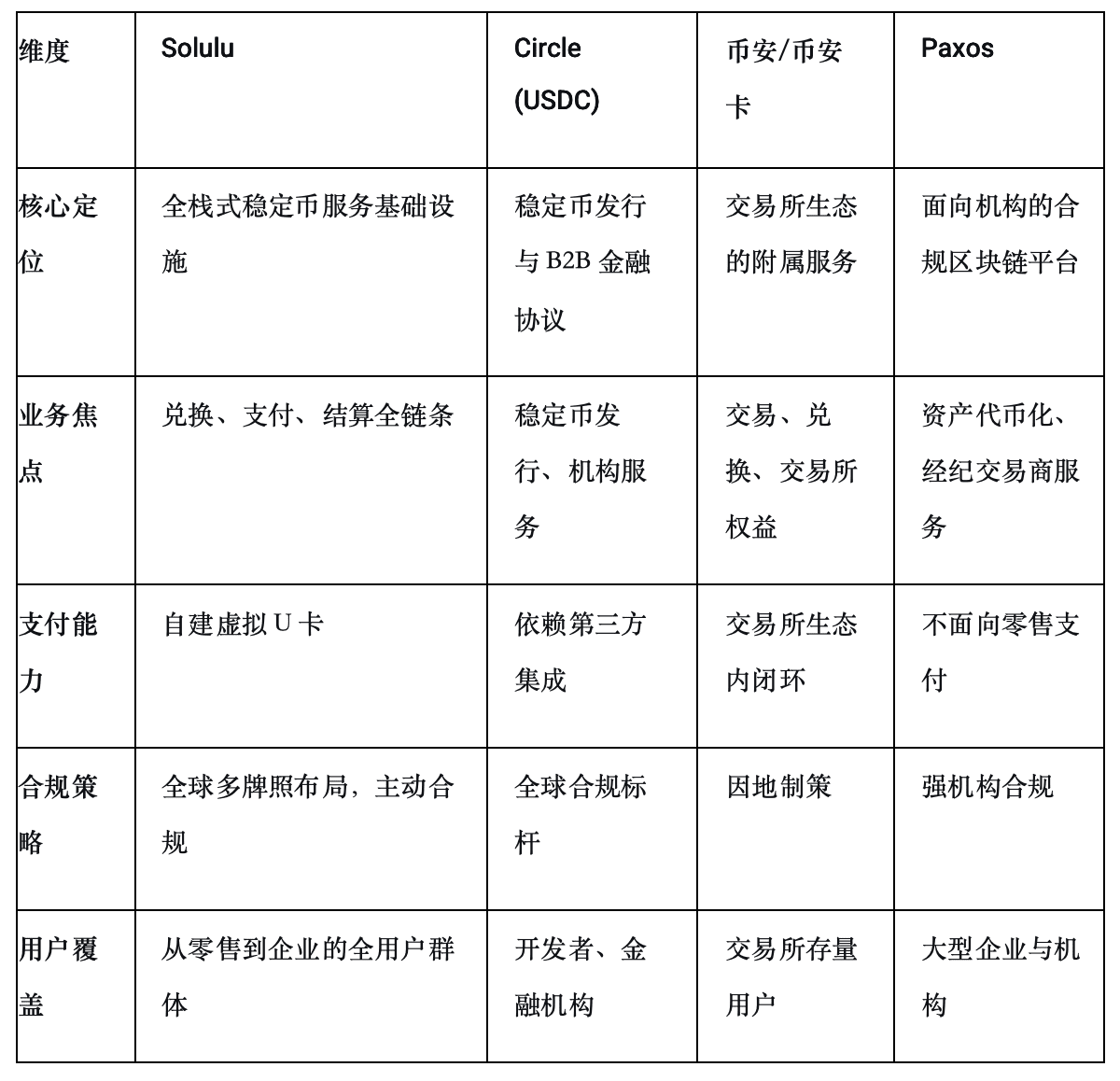
The horizontal comparison in the image above clearly demonstrates Solulu's unique positioning—it's a stablecoin infrastructure built on a full-stack service, top-tier compliance, and an independent ecosystem. More than just a simple exchange or payment function, Solulu aims to create a complete closed-loop ecosystem: integrating Visa cards, social transfers, and global settlements to ensure smooth and compliant circulation of stablecoins at every stage, from daily consumption to cross-border trade.
How will Solulu bring this grand vision to fruition?
The answer lies in Solulu's meticulously constructed four-layer business matrix—these four segments are interconnected and all point to one goal: to make stablecoins truly circulate.
The first layer, the cornerstone of liquidity: stablecoin swaps
Solulu supports instant exchange of all major stablecoins, aiming to become the world's largest multi-currency stablecoin exchange hub. This is not merely about technological connectivity, but also about liquidity aggregation, providing underlying support for all subsequent scenarios. It has already secured commitments from major financial institutions to provide liquidity support (daily exchange demand of hundreds of millions of dollars).
The second layer: Entering the real world: People's Livelihood Payment
Leveraging the compliance foundation of its MSB/MTL licenses and its deep collaboration with merchants and payment networks, Solulu directly connects stablecoins to everyday consumption scenarios, making stablecoins no longer abstract numbers on the blockchain, but "digital cash" that users can use immediately.
The third layer involves creating a closed-loop value chain: global fiat currency channels.
To break down the boundaries between on-chain assets and the real economy, simply being able to "spend" isn't enough; the ability to freely enter and exit is essential for a complete financial experience. Solulu has built a two-way fiat currency channel covering the globe (excluding China), allowing users to seamlessly convert fiat currency into stablecoins. Simultaneously, it has issued a virtual U-card that supports global spending—offering very low transaction fees, facial recognition registration, and a physical card to follow. This isn't just about piling on features; it's about genuinely improving the user experience.
The fourth layer targets a trillion-dollar market: international trade settlement.
Solulu's ultimate ambition is to target a global goods trade market with an annual scale of up to $24.44 trillion, and ultimately solve the century-old pain points of low efficiency and high cost in traditional cross-border settlement by creating a professional trade settlement platform.
It is evident that Solulu is turning its vision of a "financial highway" into reality step by step—from basic exchange to daily payments, to the free flow of global fiat currencies, and ultimately empowering top-level international trade.
How does Solulu achieve ecosystem self-driving?
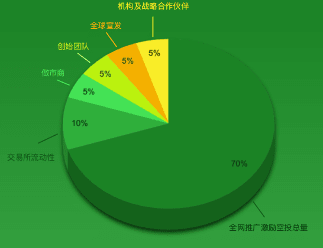
Solulu's secret to sustainable ecosystem development lies in its token economic model, designed to ensure every participant grows alongside the platform. The most compelling aspect of this model is the allocation of 70% (the maximum percentage) of the total 1 billion tokens issued—700 million tokens—to the community. This is distributed to early supporters and active users through a network-wide promotion incentive airdrop. Even more ingenious is Solulu's strategy of investing all transaction fee revenue in monthly buybacks and burns, creating a powerful deflationary engine. This makes the tokens increasingly scarce as the ecosystem expands, continuously solidifying their value and allowing holders to directly share in the platform's growth. This is a crucial commitment by Solulu to achieving sustainable development and shared prosperity with its community.
From "co-builder" to "leader", how will Solulu plan for the future?
2026 will be a pivotal year for Solulu's transformation. According to its development plan, the platform will transition from a "co-builder of a compliant ecosystem" to an "ecosystem leader," focusing on two main directions: "product deepening" and "global expansion." This includes launching a full range of retail payment services and publicly issuing U-cards, completing the deployment of its platform token and listing it on leading exchanges, while also strengthening its community foundation through airdrop incentives. Even more anticipated is the launch of "instant messaging + payment" functionality this year.
In terms of global expansion, Solulu's strategy is clear and well-defined. It will focus on advancing license applications in key markets such as VARA in the UAE and Singapore, aiming to double the number of countries supporting fiat currency channels. Simultaneously, it will launch a settlement pilot program with small and medium-sized traders, a crucial step in its strategy to penetrate the $24 trillion global trade market.
Looking ahead to 2027 and beyond, Solulu has an even more ambitious mission: to launch a dedicated on-chain trade settlement network, integrate DeFi lending and wealth management products, and ultimately become a core bridge connecting traditional finance and the crypto world.
The stablecoin sector is undoubtedly a recognized goldmine, but Solulu has chosen its most challenging path. Along this path, it must contend with potential competition from traditional financial giants, overcome complex compliance challenges, and find a precise balance between user experience and security. However, like all important infrastructure projects, true value takes time to develop. Perhaps Solulu's significance lies not only in its potential to become an industry unicorn, but also in the new possibilities it explores for the entire field—when compliance and innovation go hand in hand, and when infrastructure development takes precedence over short-term gains, the crypto world may truly be able to open the door to mainstream finance.