The x402 protocol has become incredibly popular in recent days, with everyone talking about it. But what exactly is it, and what opportunities does it present?
After quickly learning all the information available on the market, I've systematically organized it here and am sharing it with everyone for us to learn together!
To understand the x402, I think we need to look at this protocol from a higher perspective and within a broader context to truly grasp its positioning.
This all starts with stablecoin payments:
With the increasing penetration of stablecoins, stablecoin payments have also emerged and exploded.
Overall, they can be divided into three categories:
B2B payments: clearing and settlement between institutions, enterprise-level payments.
C2C payment: Payments between individuals, peer-to-peer transfers.
C2B payment: Payment from an individual to a merchant, in purchasing scenarios.
Currently, stablecoin payments are mainly carried out in the above three scenarios, but there is another potential market with huge potential: AI payments.
What are the major trends?
The future is the age of intelligence, and everything will be combined with AI.
AI Agents will become an essential tool for every individual and even every enterprise.
In the future, almost all consumer spending and business settlements can be automatically executed by AI Agents.
Based on this final state, what capability does the AI Agent currently lack?
It's basically just payment.
It's important to understand that in the traditional world, payments always require real-name KYC (Know Your Customer) verification. You need an "identity" to open a bank account and then make payments.
AI Agent is a virtual entity; how could it possibly open an account and make payments?
At this point, the emergence of stablecoin payments perfectly filled this gap.
Blockchain is decentralized, and stablecoin payments based on blockchain can enable AI agents to create addresses directly on the chain, equivalent to "opening a bank account," and use stablecoins to freely transfer funds, thus realizing the flow of value.
At this point, we discovered that the AI Agent not only had an on-chain identity, but also an on-chain account, thus truly controlling "property rights".
At this point, another problem arises: what if there is no universal stablecoin payment standard?
The x402 was born out of this need.
Next, let's take a closer look at this agreement.
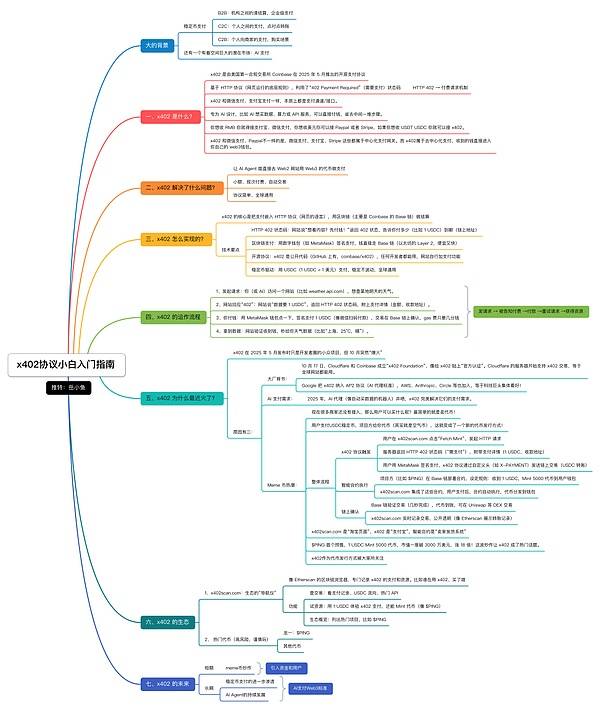
1. What is x402?
x402 is an open-source payment protocol launched by Coinbase, the first compliant exchange in the United States, in May 2025.
This protocol is based on the HTTP protocol (the underlying rules for web page operation) and utilizes the "402 Payment Required" status code, hence the name x402.
Simply put, x402, like WeChat Pay and Alipay, is essentially a payment channel/interface.
However, the x402 is designed specifically for AI. For example, if AI wants to buy data, computing power, or API services, it can pay directly, saving a bunch of intermediate steps.
If you want to receive RMB, you need to accept Alipay or WeChat Pay. If you want to receive USD, you can accept PayPal or Stripe. If you want to receive USDT or USDC, you can accept x402.
Unlike WeChat Pay, Alipay, and Stripe, which are all centralized payment gateways, x402 is a decentralized payment platform where received funds go directly into your own web3 wallet.
II. What problem did x402 solve?
In 2025, with the rapid development of AI, AI agents will encounter a very big problem:
AI is like a super smart assistant; it wants to look up data, use APIs, and buy computing power, but it can't log into websites, enter passwords, or swipe cards like a human.
Traditional payment methods (credit cards, PayPal) are too slow, too complicated, and charge 2-3% transaction fees, making them unsuitable for AI's "micro-payment" needs (buying data for a few cents).
Therefore, the main problems that x402 solves are :
AI-powered autonomous payments : AI can pay for services directly, just like a human, such as accessing a weather API for 1 USDC, eliminating the need for human intervention.
The challenge of micropayments : Traditional payment methods charge high fees (such as 2% per transaction for credit cards), while the x402 uses blockchain (based on the Base chain) to charge only ultra-low gas fees (a few cents), making it suitable for small transactions.
Simplified process : No registration or authentication required. x402 makes payment as simple as sending a message. It's native to HTTP, and developers can integrate it with just one or two lines of code.
Globally accepted : Use stablecoins (such as USDC), which can be used worldwide, and exchange rates are worry-free.
The x402 is like giving AI a "digital wallet," allowing it to pay for things anytime, anywhere, saving time and effort, and at a lower price!
The x402 can be considered the "last mile" of AI payment.
III. How is x402 implemented?
The core of x402 is to embed payments into the HTTP protocol (the language of web pages) and use blockchain (mainly Coinbase's Base Chain) for settlement.
It sounds complicated, but it's really just like adding a "payment button" to a webpage.
Here is a brief list of the key technical points:
HTTP 402 status code : The website says "Want to see the content? Pay first!" and returns a 402 status code, telling you how much (e.g., 1 USDC) to where (on-chain address).
Blockchain payments : Use a digital wallet (such as MetaMask) to sign payments, and the money goes directly through the Base Chain (Ethereum's Layer 2, which is cheap and fast).
Open source license : x402 is open source code (available on GitHub, coinbase/x402), which any developer can use, similar to a "free blueprint" to add payment functionality to a website.
Stablecoin-driven : Payments are made in USDC (1 USDC = 1 USD), stable and volatile, and universally accepted globally.
Simply put, the x402 is like having an "Alipay QR code" installed on a webpage. The AI can scan the code to pay, and the website immediately provides the AI with information.
IV. Operational Procedures of X402
To give a practical example, suppose you (or an AI) want to buy weather API data using x402.
The process is as follows:
Initiate a request : You (or AI) visit a weather website and want to check the weather in Shanghai tomorrow.
The website responded with a "402" error : The website stated that "the data requires 1 USDC" and returned an HTTP 402 status code, along with payment details (amount and receiving address).
You pay : Simply tap your MetaMask wallet to sign and pay 1 USDC (like WeChat QR code payment). The transaction is confirmed on the Base chain, and the gas fee is only a few cents.
Once you receive the data : the website verifies receipt of payment and instantly provides you with weather data (e.g., "Shanghai, 25°C, Sunny").
To summarize the whole process: Send a request → Be informed of the payment → Pay → Retry the request → Obtain the resource.
V. Why has the X402 become so popular recently?
When x402 was released in May 2025, it was just a niche project in the developer community, but it suddenly became a hit in October.
There are three main reasons:
Endorsement from a major company :
On October 17, Cloudflare and Coinbase established the "x402 Foundation," essentially giving x402 "official certification."
Cloudflare servers have begun supporting x402 transactions, meaning websites worldwide can now use them.
Google has included the x402 in the AP2 protocol (AI agent standard), and AWS, Anthropic, Circle, and others have also joined in, which means that tech giants are collectively optimistic about it!
AI payment needs :
In 2025, AI agents (like robots that automatically buy data) will proliferate, and the x402 perfectly solves their payment needs.
Meme Coin Craze :
Many merchants haven't integrated yet, so what can users buy? The simplest way is to sell tokens!
Users pay with USDC stablecoins, and the project team gives you tokens (which are essentially worthless tokens), thus creating a new way of issuing tokens!
The overall process is as follows:
The first step is to trigger the x402 protocol.
The user clicks "Fetch Mint" on x402scan to initiate an HTTP request.
The server returned an HTTP 402 status code ("Payment Required"), along with payment details (1 USDC, receiving address).
Users sign payments using MetaMask, and the x402 protocol sends on-chain transactions (USDC transfers) via custom headers (such as X-PAYMENT).
The second step is the execution of the smart contract.
Project teams (such as $PING) deploy contracts on the Base chain, setting rules: upon receiving 1 USDC, 5000 Mint tokens will be deposited into the user's account.
x402scan integrates these contracts; after a user makes a payment, the contract executes automatically, and the tokens are distributed to the wallet.
The third step is on-chain confirmation.
Base Chain verifies transactions (completes in seconds), tokens are credited to your account, and can be traded on DEXs such as Uniswap.
x402scan records transactions in real time, providing transparency (similar to Etherscan's display of transfer records).
Simply put, x402scan is the "Taobao page", x402 is "Alipay", the smart contract is the "seller's delivery system", and the minted tokens are the "goods for sale".
The first pre-sale of $PING, with 1 USDC Mint for 5000 tokens, once boosted the market value to over $30 million, an 18-fold increase! This hype made x402 a hot topic.
In short, x402 is currently attracting attention as a token issuance method.
VI. How exactly do I participate in x402?
x402 is not just a protocol, but also an ecosystem, with core tools and projects as follows:
1. x402scan:
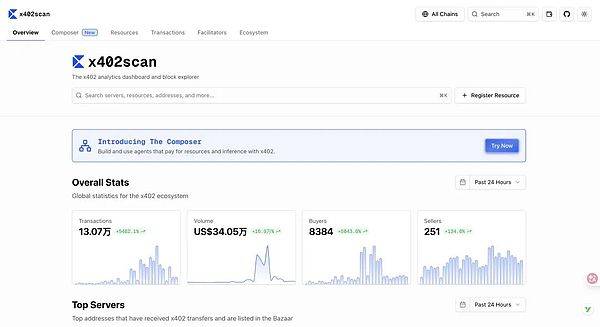
Blockchain explorers like Etherscan specifically record x402 payments and resources, such as who is using x402 and what they have purchased.
Core functions :
Check transactions : View payment records, USDC flow, and popular APIs.
Trial resources : Experience x402 payments with 1 USDC, and also get Mint tokens (like $PING).
Ecosystem Overview : Lists popular items, such as $PING.
2. Popular tokens (high risk, play with caution)
These tokens were issued riding the x402 craze, but their volatility has been like a rollercoaster:
$PING : x402 is the leading meme coin, a Base chain coin. 1 USDC Mint equals 5000 tokens. Its market capitalization once reached $30 million, representing an 18-fold increase.
$SANTA : AI agent related, Virtuals ecosystem, 1 USDC Mint, market capitalization is doubling.
$PAYAI : Solana cross-chain technology, AI payment narrative, and community buzz.
$GLORIA : x402 Information AI, recently doubled in price.
These tokens are mostly speculative with weak fundamentals. They're like buying lottery tickets; you might make a fortune, or you might lose everything.
You can find a resource on the x402scan website (e.g., $PING), and click "Try Resources" → "Fetch Mint".
Pay 1 USDC, sign to confirm, and the token will be credited to your account (like buying game skins).
If you want to trade, you can sell on Uniswap (Base chain), but be aware of slippage (5-10%).
Other ways to play:
Developer: Want to add x402 payment to your website? Check out the code on GitHub (coinbase/x402), it only takes a few lines.
AI Player: Testing API payments with x402scan and experiencing AI automatically buying data.
Follow trending topics: On x402scan, keep an eye on new tokens (like $PONG), but don't chase the highs!
VII. What is the future of the X402?
The potential of the x402 lies in making AI and app payments as ubiquitous as sending an email.
In the short term, it is still in the hype stage, with people attracted by the wealth effect of meme coins in the x402 ecosystem.
However, with funding and market attention, the development of this sector will accelerate.
In the long run, as more websites support x402, AI agents will use it to buy data and computing power, and this will become more widespread with the AI boom.
This protocol could become the Web3 payment standard, much like HTTPS is to Web2.
If you believe in the future of stablecoin payments and AI agents, then you must pay attention to this sector!